
4176 Meridian Street

Bellingham, WA 98226

(360) 758-2200

24/7 Emergency Care​

Living Well in the Senior Years

Caring for Lacey Through Cushing’s Disease

How a multidisciplinary approach to care helped a senior dog maintain comfort, mobility, and joy

Lacey, a senior Maltese–Yorkie mix, faced multiple age-related challenges—including Cushing’s disease and declining mobility—that threatened her comfort and quality of life. With coordinated care from Boundary Bay’s Internal Medicine and Rehabilitation teams, she regained stability, confidence, and a renewed joy in everyday family moments.

1. Case Overview

Patient 

Name: Lacey
Breed: Maltese–Yorkie Mix
Age: 15–16 years (female) 

Service & Date 

Internal Medicine evaluation and long-term management of Cushing’s disease, followed by ongoing rehabilitation therapy, provided at Boundary Bay Veterinary Specialty Hospital (BBVSH) – Bellingham. Care began approximately 18 months prior and continues with regular follow-up. 

Quick Facts 

  • Presented with increased appetite, urinary incontinence, hair thinning, and reduced mobility 
  • Diagnosed with Cushing’s disease through advanced hormonal testing and imaging 
  • Managed with long-term, twice-daily medication tailored to her response 
  • Enrolled in structured rehabilitation to address stiffness, weakness, and mobility decline 
  • Demonstrated marked improvement in comfort, posture, confidence, and daily activity 

Care Team Perspective 

Lacey’s case highlights the value of multidisciplinary specialty care, combining internal medicine expertise with rehabilitation services. Her treatment plan was carefully designed to balance medical effectiveness with the realities of an aging body, prioritizing comfort, safety, and quality of life at every stage.

Lacey’s family first became concerned when subtle changes began to add up. She was eating constantly, experiencing frequent urinary accidents in the house, and developing a noticeably thinner coat. These changes felt unusual, even for a senior dog. As Kimberly explained, “It just wasn’t normal behavior—we felt like something was wrong.” 

After an initial visit with their primary veterinarian, Lacey was referred to Boundary Bay’s Internal Medicine team for further evaluation. Around the same time, her mobility also began to decline. She became stiff, slow to move from room to room, and less engaged in activities she once enjoyed, such as wandering the yard or keeping up with her family. 

The combination of systemic signs and physical decline raised concerns not only about an underlying medical condition, but also about how best to support Lacey’s comfort as she aged. Kimberly emphasized that the family wanted guidance that balanced treatment with compassion: finding the line between doing enough—and doing what was right for an older dog.

2. Presenting Problem

3. Diagnosis

At BBVSH, Lacey underwent a comprehensive internal medicine evaluation. Based on her clinical signs, the team developed a —a standard veterinary approach that outlines possible causes for symptoms before testing confirms the answer.  
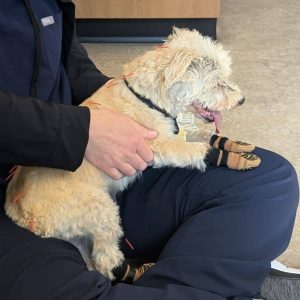
Advanced diagnostics were performed, including hormonal testing to evaluate levels of cortisol (a hormone that helps the body manage stress) and an abdominal ultrasound to assess the adrenal glands (two small organs near the kidneys that produce hormones). These tests confirmed a diagnosis of Cushing’s disease (hyperadrenocorticism), a condition in which the body produces a harmful excess of cortisol. Kimberly described learning that the disease can arise either from the brain’s hormonal control system (a “command center” called the pituitary gland that tells the body when to make hormones) or from the adrenal glands themselves (the “factory” that actually makes the hormone)—an important distinction, as brain-based cases are usually managed with medicine while gland-based cases may require surgery. 

Further testing helped determine that Lacey’s condition could be managed medically rather than surgically. This clarity allowed the care team and family to move forward with a treatment plan focused on long-term stability and quality of life. 

Final Diagnosis: Cushing’s disease (hyperadrenocorticism), with secondary effects on coat quality, urinary control, and mobility. 

Lacey’s treatment began with medical management of Cushing’s disease, using prescription medication to regulate cortisol levels. After careful dose adjustments and follow-up testing, the team determined that twice-daily dosing provided the most consistent control for her body. Kimberly noted significant improvements: reduced thirst and urination, resolution of in-home accidents, improved comfort, and a noticeably healthier coat. 

Throughout this process, the Internal Medicine team prioritized shared decision-making. Surgical options were discussed but ultimately ruled out due to Lacey’s age, size, and the risks associated with invasive procedures. Instead, the focus remained on what was feasible, safe, and beneficial for a senior dog. 

As Lacey’s hormonal disease stabilized, attention shifted to her mobility and stiffness, which were limiting her independence. She was enrolled in Boundary Bay’s Rehabilitation program under Dr. Henderson, beginning with weekly sessions and later transitioning to every-other-week visits.
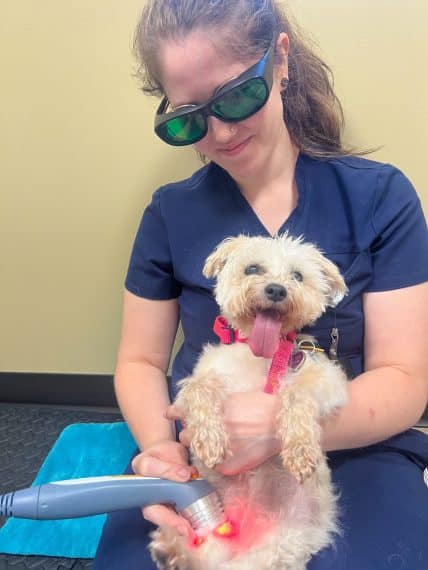
Her rehabilitation plan included: 

  • Acupuncture 
  • Cold laser therapy 
  • PEMF support 
  • Gentle range-of-motion and strengthening exercises 
  • Customized at-home exercises for continued progress 

Kimberly described the impact of acupuncture as especially striking, watching Lacey visibly relax during sessions. Over time, Lacey transitioned from a rigid, “bulldog-like” stance to moving with greater ease, balance, and confidence. 

4. Treatment

5. Outcome

The results of Lacey’s combined medical and rehabilitation care were both immediate and meaningful. As her Cushing’s disease came under control, her energy improved, her coat thickened, and her overall comfort increased. With rehabilitation, her posture straightened, stiffness eased, and mobility returned. Kimberly recalls moments that felt almost unbelievable—like watching Lacey confidently walk over uneven forest ground dotted with pinecones. 

Perhaps most telling was Lacey’s enthusiasm for her rehab visits. “She wants to go,” Kimberly shared. “She walks in, sees her team, and it’s like, ‘Okay, bye—I’m going to do my workout now.’” 

Not long ago, the family worried Lacey might not make it to her 16th birthday. Today, they are planning a joyful celebration. Kimberly reflected, “We went from thinking the kindest thing might be letting her go, to having this extra time and quality of life.” 

Prognosis & Takeaway: With continued medical monitoring and supportive rehabilitation, Lacey is expected to maintain good comfort and function. Her case illustrates how thoughtful, individualized specialty care can profoundly change what aging looks like—for both pets and their families.

Contact BBVSH Bellingham

Please fill in your contact details and a message below. We’ll be sure to contact you within the next business day.

Alternately, call (360) 758-2200, email bellingham@bbvsh.com, or fax 1 (888) 867-6928.

If you have an emergency, please call (360) 758-2200.