

Patient Details
Name: Juneau
Breed: Maine Coon
Age: Approximately 1 year old at the time of treatment
Service
Department: Internal Medicine & Surgery
Treatment Date: February–April 2025
Quick Facts
Juneau was referred to Boundary Bay Veterinary Specialty Hospital after months of persistent upper airway congestion failed to respond to medical treatment. Advanced evaluation by the Internal Medicine and Surgery teams identified a large nasopharyngeal polyp obstructing his airway.
Following minimally invasive treatment, Juneau made an excellent recovery. Today, he breathes comfortably, enjoys an active, playful lifestyle, and has returned to the energetic personality his family always knew.
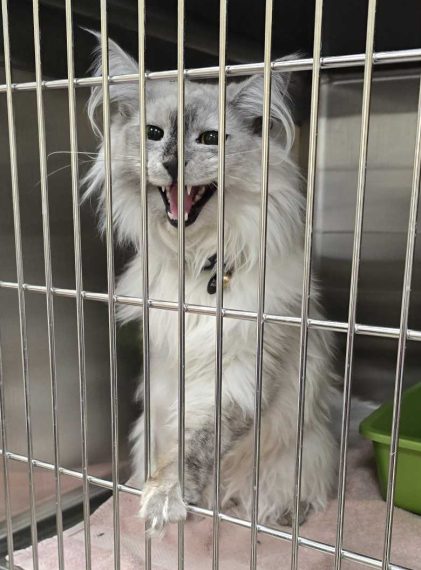 When Riley Pena brought home Juneau, she expected life with a playful Maine Coon kitten. What she didn’t expect was months of veterinary appointments, medications, and wondering whether her new companion would ever breathe normally.
Shortly after arriving home, Juneau was diagnosed with giardia, an intestinal parasite that was successfully treated by his primary care veterinarian. Soon afterward, however, he developed persistent nasal congestion that simply never went away. Despite multiple courses of treatment for what appeared to be an upper respiratory infection, his breathing became progressively louder and his nose constantly discharged mucus.
“He acted completely normal,” Riley recalls. “Other than that, it was just sad that it was streaming from his nose. We could hear him around the house by how he breathed. There was no sneaking around.”
Despite ongoing treatment, Juneau’s symptoms continued to worsen. His nostrils often appeared nearly blocked, thick nasal discharge became a constant part of daily life, and Riley began to worry about his breathing.
“It got to the point where his nostrils were closed, and I was worried about him breathing. There would be snot dripping—actually dripping.”
What made the situation especially frustrating was that Juneau otherwise behaved like a perfectly healthy kitten. He continued eating, playing, learning tricks, chasing dogs, and enthusiastically playing fetch.
“I kept thinking, ‘Why is this continuing for so long?’ Nothing was helping it. We just knew it had to be something else.”
Recognizing that appropriate first-line treatment wasn’t resolving Juneau’s condition, Riley’s primary care veterinarian referred him to the Internal Medicine team at Boundary Bay Veterinary Specialty Hospital for advanced evaluation.

Persistent nasal congestion in young cats can have many possible causes. Differential diagnoses included:
By the time Juneau arrived at Boundary Bay Veterinary Specialty Hospital, months of medical therapy had failed to resolve his symptoms. During an examination under anesthesia, specialists identified the source of the obstruction—a remarkably large nasopharyngeal polyp.
Nasopharyngeal polyps are benign inflammatory growths that originate from the lining of the middle ear (the tympanic bulla) and can extend into the back of the throat, obstructing normal airflow through the nasal passages.
For Riley, finally having an answer after months of uncertainty was an enormous relief.
“They told me he had a polyp this big. I didn’t even know what a polyp was before. I think it was one of the biggest ones they’d ever seen.”
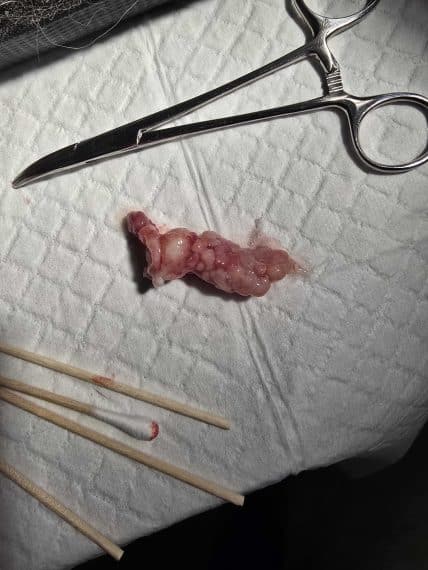
Because the obstruction was identified during examination under anesthesia, advanced imaging such as CT and rhinoscopy were not required before treatment.
“This is a good example of how specialists work together to determine the most financially efficient path forward,” explains Dr. Milan Milovancev. “We had advanced imaging available if we needed it, but by carefully examining Juneau under anesthesia, we were able to identify the lesion, avoid unnecessary testing, and still achieve the best possible outcome.”
Treatment included:
Traction avulsion involves carefully removing the polyp through the mouth from its point of attachment. Dr. Milan compares the procedure to pulling a weed.
“If you only remove the part you can see, it may grow back,” he explains. “The goal is to remove the root of the weed as well.”
Pathology confirmed the growth was benign. Because the polyp was successfully removed, Juneau did not require a more invasive ventral bulla osteotomy (VBO).
For Riley, deciding to proceed with surgery wasn’t difficult.
“They said we could either look and see what was there, or not know and just live with it. I thought, ‘We might as well find out.’”
The improvement was immediate. Juneau’s congestion resolved following surgery, and Riley noticed a dramatic difference in his breathing almost immediately.
Recovery at home was straightforward.
Postoperative care included:
Dr. Milan explains that the nerve controlling pupil size passes through the middle ear where these polyps originate. Temporary irritation may occur as the area heals and can indicate that the tissue of origin was successfully removed, making recurrence less likely.


Today, Juneau is a healthy, energetic young Maine Coon with a larger-than-life personality. He spends his days playing fetch, chasing dogs many times his size, and keeping everyone around him entertained.
His chronic congestion has completely resolved, and he continues to do well following treatment.
Looking back, Riley is grateful that her primary care veterinarian recognized when it was time to seek specialty care.
“I would say they’re probably the best option out there when it comes to specialty things. Whenever somebody asks me about specialty care, I tell them Boundary Bay.”
For Riley, however, the greatest measure of success wasn’t found in the diagnosis or the surgery—it was hearing something she’d never heard before.
“He purred, and he trilled…I almost wanted to cry because I thought, ‘He’s probably so happy.’”
Juneau’s case highlights the importance of investigating persistent respiratory signs that fail to respond to treatment. Through collaboration between primary care and specialty medicine, the underlying cause was identified, treated, and his quality of life restored.
Today, Riley no longer hears Juneau breathing from across the house.
She hears him purr.

